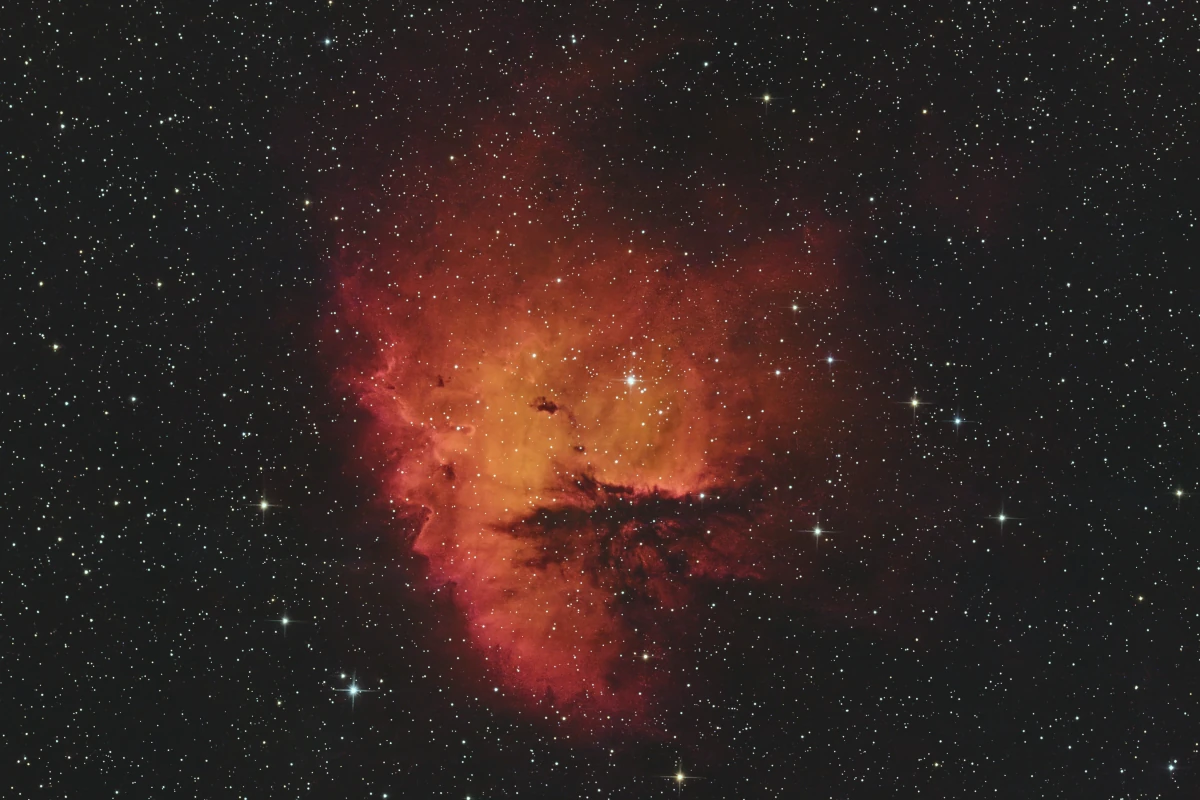
The Pacman nebula, so named because it looks a bit like the 1980’s hit video game character Pac-Man, is an emission nebula located in the constellation Cassiopeia,
It has numerous tendrils of dark nebula, particularly distinctive in the lower half. It is located around 9,200 Ly away and has a diameter of approximately 48 Ly.
The nebula also features a small open cluster IC 1590 and quintuple star system B1 (HIP 4121).
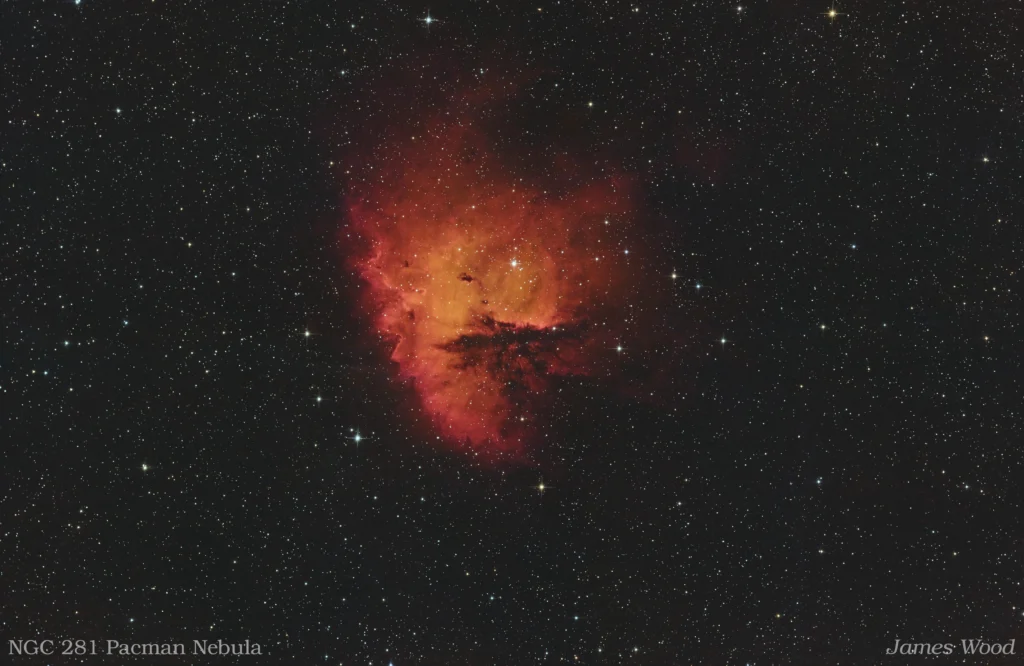
Capture
I captured data over four sessions in July using my Sky-Watcher 150PDS and astro modified Canon 600D; The first session was with a Laida duo-band Ha / OIII filter, 145 x 60s at ISO 3200, I had good seeing that night and was able to capture a good amount of detail.
The second session I captured more Ha data, however the seeing had degraded or it was out of focus (this was before I had an EAF) so in the end I decided to discard that data.
The third session I used an Askar Colour Magic C2 SII / OIII duo-band filter and captured 100 x 60s at ISO 3200.
The final session I captured 32 x 60s with a UV / IR cut filter, primarily to capture the star colour.
Processing
This is the first time I’ve processed an image with two duo-band filters so it took a while and numerous tries to figure out how to do it, as usual I used RawTherapee to inspect my images and Siril and GIMP to process them.
I stacked the data of the two filters with the OSC_Extract_HaOIII script and afterwards stacked the two resulting OIII images, the broadband data was stacking with the OSC_Preprocessing script, the stars were then extracted with RC Astro StarXTerminator.
The Ha, SII, OIII and stars were then registered, I used the RGB composition tool to combine the frames, opting for a HOS palette, then extracted the stars from that.
After stretching and denoising I used VeraLux Star Composer to add the stars back in from the broadband data.
Final processing was done with RC Astro BlurXTerminator and NoiseXTerminator, as well a VeraLux Revela to highlight the nebula detail and curves adjustment with VeraLux Curves.
While I wouldn’t say I’ve got the workflow down perfectly, there is definitely room for improvement, I am quite happy with the results.